Letchworth Golf Club

Rule of the Month - Preparing for and Making a Stroke

Rule 10 - Preparing for and Making a Stroke; Advice and Help; Caddies
10.1 - Making a Stroke
Purpose of Rule: Rule 10.1 describes how to create a stroke as well as a number of actions that are forbidden when doing so. Using a club's head to fairly strike a ball is called a stroke. The main problem is to freely swing the club without anchoring it in order to direct and control the movement of the entire club.
10.1a - Fairly Striking the Ball
In making a stroke:
- The player cannot push, scrape, or scoop the ball; instead, they must fairly hit at it with any part of the club's head so that there is only brief contact between the club and the ball.
- There is only one stroke and no penalty if the player's club unintentionally touches the ball more than once.
10.1b - Anchoring the Club
In making a stroke, the player must not anchor the club either:
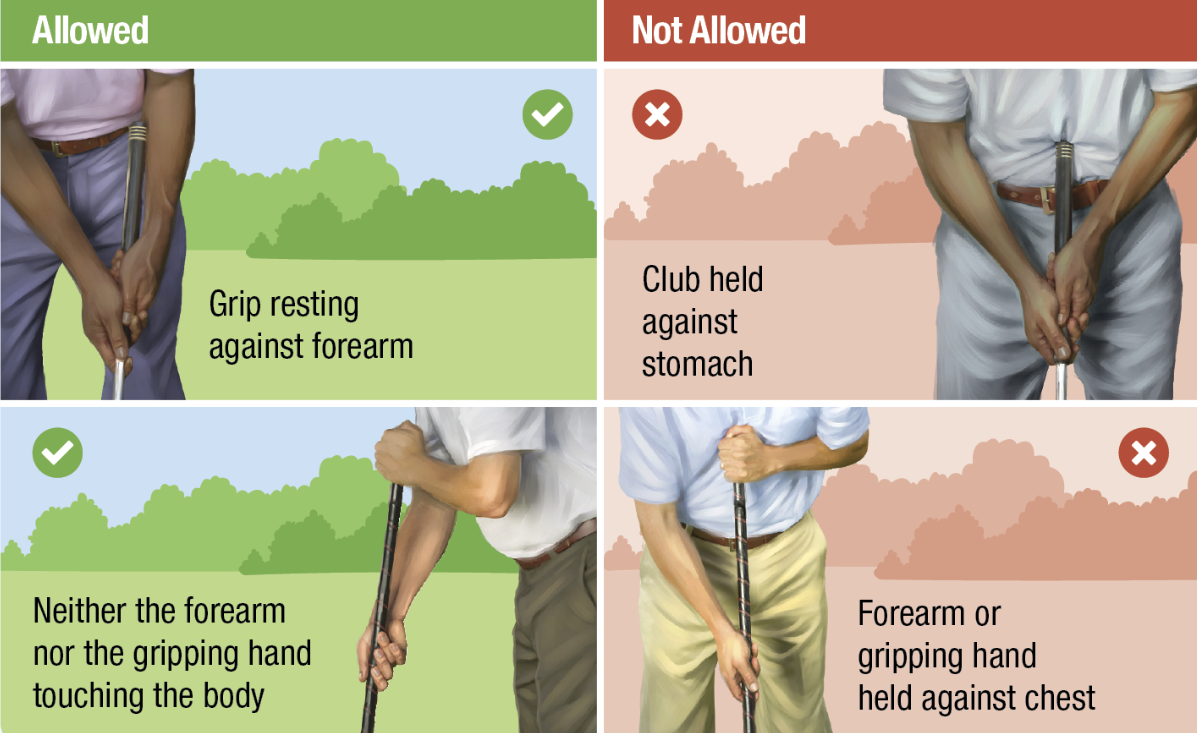
- Directly, by pressing the club or a gripping hand against any body area (with the exception of the player's hand or forearm).
- Indirectly by using a gripping hand as a secure point around which the other hand may swing the club by pressing the forearm into any portion of the body.
This rule is not broken if the player's club, gripping hand, or forearm just makes contact with their body or clothing during the stroke—that is, if it is not held against the body.
The area of the arm below the elbow joint, including the wrist, is referred to as the "forearm" for the purposes of this rule.
10.1c - Making Stroke While Standing Across or on Line of Play
A stance in which one foot is intentionally placed on either side of the line of play or an extension of that line behind the ball, or in which either foot is intentionally touching the line of play, prevents the player from making a stroke.
For this Rule only, the line of play does not include a reasonable distance on either side.
Exception - There is No Penalty if Stance is Taken Accidentally or to Avoid Another Player's Line of Play.
10.1d - Playing Moving Ball
A player must not make a stroke at a moving ball:
- A ball in play is 'moving' when it is not at rest on a spot
- If a ball that has come to rest is wobbling (sometimes referred to as oscillating) but stays o or returns to its original spot, it is treated as being at rest and is not a moving ball
But there are 3 exceptions where there is no penalty:
Exception 1 - Ball Begins to Move Only after Player Begins Backswing for Stroke: Making a stroke at a moving ball in this situation is covered by Rule 9.1b
Exception 2 - Ball Falling Off Tee: Making a stoke at a ball falling off a tee is covered by Rule 6.2b(5)
Exception 3 - Ball Moving in Water: When a ball is moving in temporary water or in water in a penalty area:
- The player may make a stroke at the moving ball without penalty
- The player may take relief under Rule 16.1 or 17, and may lift the moving ball
In either case, the player must not unreasonably delay play to allow the wind or water current to move the ball to a better place.
Penalty for Making Stroke in Breach of Rule 10.1: General Penalty. In stroke play, the player gets 2 penalty strokes.
Download the R&A App - Click HERE
Created by intelligentgolf version 10.1.2.